Wednesday, November 9, 2011

A Morelia!

After five action packed days in San Miguel raising awareness and funds for Sergio Castro, we said goodbye to Casa Luna and Team Sergio and hopped a cab to Celaya, where we'd board a bus to Morelia. And who did we call for the cab? You got it, Pedro the photographer, who informed us that he was a singer in a trio of four. We crooned our way through Sin Ti and Camino de Guanajuato right up to the bus station door.


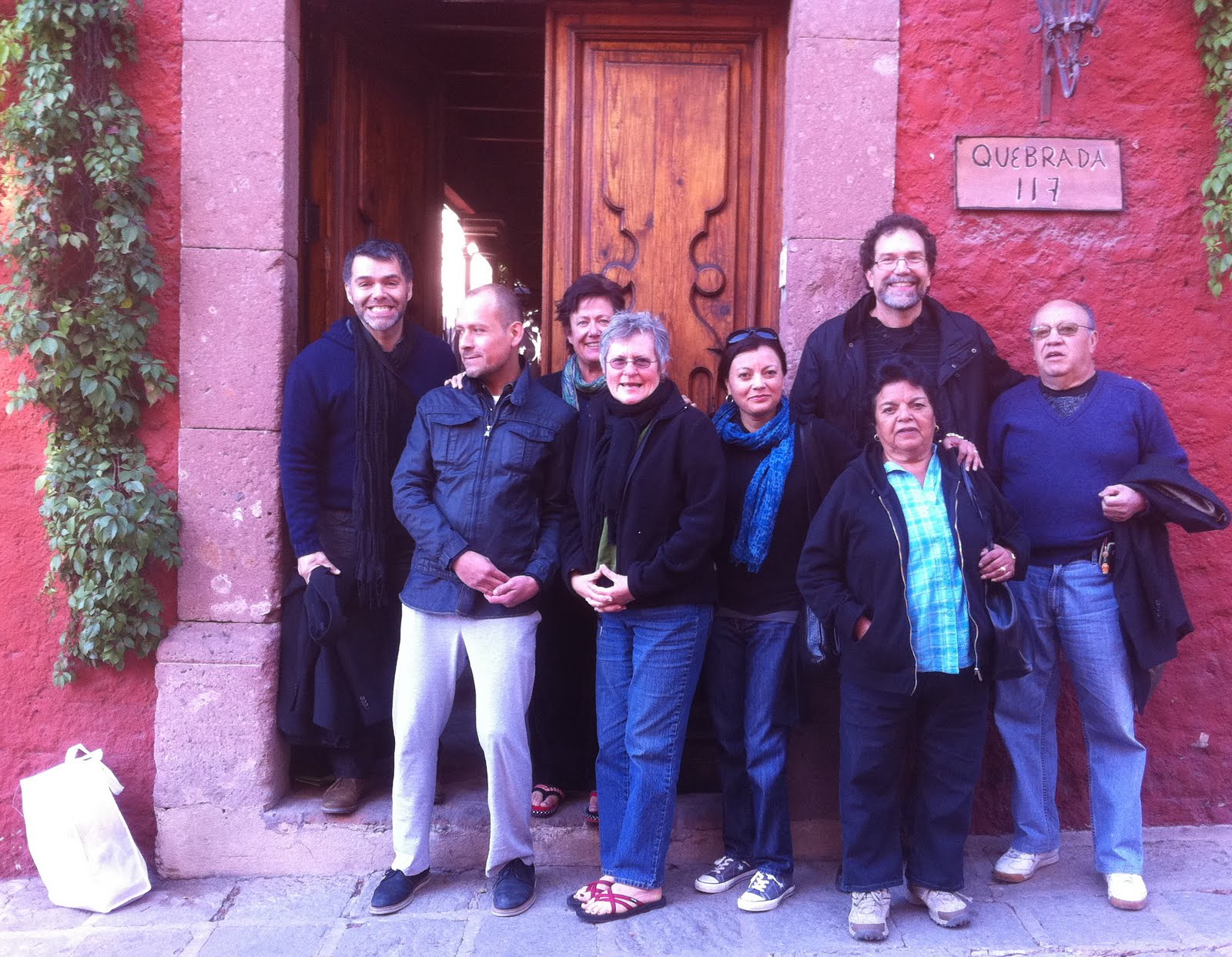
L to R, Victor (aka: DJ XXX); Mayolo (king of late-night mariachi karaoke on the jardín), me (queen of the same), Jane, Consuelo, John, & Chelo's parents, Gloria and José.


Buses in Mexico are a beautiful thing, comfortable, clean, affordable, and on time. By mid-afternoon Jane and I were at the Hotel Soledad in downtown Morelia. I adore this place. I've been staying there since forever and it has always been a lovely, perfectly located, mid-priced hotel. The location still can't be beat, but now it's a superb and only slightly above mid-priced hotel. The new owner, Leticia, has some seriously good taste and the staff is just the best.
Drinks in the courtyard during a previous tour. Note the moat-like water feature around the fountain and remind me to tell you about the swim I took in it some time.

Jane hadn't spent more than a couple of hours in Morelia, so we set out to see the town. And eat a gaspacho. Yes, that's gaspacho with an S, not a Z. Don't blame me, I'm just telling you what's what, not why. Thing is, first taste and you won't care how it's spelled, your only thought will be "How soon before I can have another one?"

What is it, you ask? It's an only-in-Morelia flavor-saturated miracle of culinary bliss. Chopped pineapple, mango, and jicama piled in a plastic cup, topped with fresh orange and lime juices, grated cheese, and chile. It's sweet, saltly, rich, sour, bitter, hot as well as soft and crunchy all in the same bite. It's to die for. Just writing about it makes my salivary glands go nuts. Here's my recipe for making it at home.
The one in the middle has watermelon as well, but I'm a purist and go for the original. Extra chile, por favor.
Morelia-style Gaspacho
This is the classic version, but there are as many variations of this as there are Morelianos who make it. Some add watermelon, cucumber, I've even seen onion included (horrors!) The most important part of the recipe is that everything be evenly and finely chopped so that you always have a balance of ingredients in every bite.
Ingredients: (2 hefty portions)
1 cup of mango
1 cup of jicama
1 cup pineapple
6 teaspoons grated Cotija cheese
Valentina Sauce to taste
Salt to taste
Red/black chile, ground (Not SW chili powder, but ground chile, like chile de arbol or ancho. Toast and grind it yourself if need be.)
1 orange
1 lime

Chop the pineapple, mango, and jicama into small cubes of the same size and toss them together. Place about a third of the chopped fruit in two large plastic or glass cups. Top each with 1 teaspoon of the cheese, a splash of salsa, a sprinkle of ground chile, and salt. Repeat twice, and on the last layer squeeze the orange and lime over the fruit before you add the cheese, salsa, chile, and salt. Serve Valentina or Tapatio Sauce on the side.
I've heard tell of people pouring a chilled shot of tequila blanca over it., let me know if you try that.

So, back to Morelia...

Our gang of four - John from Connecticut, Susan from California, Jane, and me - finally all came to roost in Morelia late Friday night. On Saturday we piled into the rental car and headed west to Lake Camecuaro, where we would be spending the night tonight in order to be near the village of Patamban early on Sunday morning.

But first, a stop at Horno Los Ortiz, quite possibly the most creative bakery in Mexico. The bakery is wonderful any day of the year, but it really rocks during Day of the Dead, when Judith sets up her ever-growing display of bread figures that inhabit her "pan-teón." (Get it? PANteón?)

Judith and Hugo of Horno Loz Ortiz


Judith's fantastic bread figures in the Pan-teón

The Virgin of Guadalupe rendered in bread

We loaded up on tasty treats, but not before we heard the stories. Judith regaled us with humorous but poignant tales of how and why she created certain pastries: the Rollo de Canela con piquete (cinnamon roll with a splash of tequila) and the Guangoche, a packet of pastry stuffed with apple slices and cheese and tied with twine that looked like a burlap lunch bag. Both these pastries were dedicated to los mojados, wetbacks literally, but used by Judith to describe any Mexican living in the USA now.

The other remarkable artist we met that day was Jenya (short for Eugenia), Judith and Hugo's daughter, a seventeen year-old helper in the bakery who makes incredibly fine papel picado art. She brought out a piece she is currently working on, a Virgen of Guadalupe about 3-feet tall. Stunning!


Jenya with her latest work of art


Detail

It was now mid-afternoon and we'd made it exactly 1/2 mile from the hotel. My kind of pace.

Monday, November 7, 2011

On a mission in Mexico, Part 2

On Monday, October 24 (a mere two weeks ago, how can that be?) Jane and I met with John and Consuelo, the filmakers responsible for El Andalón, a documentary film on the work of my hero Sergio Castro, and Mary Murrell and Ivan Schuster, the couple behind the fund raising events for Sergio in San Miguel. Team Sergio was beginning to gel. Over cappuccinos on the jardín, we introduced ourselves to one another and learned more about the plan of events for the next few days.
(Note surprised look on the gal at the table on the left. I think she might have mistaken us for famous people.)

Sergio and his wife would arrive from Chiapas later that day. (What a coup to have them here; Sergio rarely travels away from San Cristóbal, where his many patients need him on a daily basis.) Patricia Ferrer, a physician's assistant from Tucson who travels to Chiapas twice a year for two weeks to work side-by-side with Sergio, would be in San Miguel late that night, along with her physical therapist friend Kathleen and the 200+ pounds of medical supplies they carried with them. They were both en route to Chiapas but had squeezed in two days in San Miguel to help with the fund raising events.
Patricia, arriving in San Miguel

Mary's local helpers Iri and Olivia were busy building forms on which the trajes would be displayed and with preparations of food and drink for over 100 people. More local pals were scheduled to take tickets and otherwise assist at both events. The San Miguel bilingual paper, Atención, had just run the second of Mary's beautifully written articles about Sergio's work and his upcoming visit. Posters were up around town, the buzz was building. Everywhere we went we talked about Don Sergio and El Andalón and people responded enthusiastically; two guests at Casa Luna, our gorgeous home-away-from-home in San Miguel, bought tickets for both events and went about spreading the word to others.

On Tuesday morning a visit to Patronato de Niños, a fabulously successful and venerable non-profit organization in San Miguel that provides free of low-cost medical and dental care to low-income children, was planned.

Tuesday afternoon Mary and Ivan would host a luncheon and planning session for Team Sergio at their home. Tuesday night was the first of the two public events scheduled: the screening of El Andalón at the Angela Peralta Theater. Wednesday the Sala Quetzal at the Biblioteca was reserved for a showing of a portion of Sergio's
traje collection. On Thursday Sergio and Elsa would head back to Chiapas, Patricia and Kathleen would be there to greet them, and they'd be back at work helping and healing by Friday.

Our days were full. I was engaged. Engaged as in a gear that was properly meshed, interlocked and interacting with the other moving parts - in this case, Team Sergio. It felt beyond enlivening.

Tuesday dawned clear and cool. Sergio and Elsa had arrived safely, Patricia and Kathleen and the 200+ pounds of supplies were also in town. We all met up for the Patronato visit, an inspiring time. Pedro, the taxi driver who brought us back to town, became our new best friend and member of Team Sergio and offered to take the group shots at the Mirador, coaching us into the best poses.
L to R, Consuelo, me, Sergio, Elsa, Patricia, Jane, Consuelo's parents Gloria and José, and Kathleen.
Photo by Pedro the taxi driver.

The luncheon was just lovely, Mary and Ivan's beautiful home a marvelous backdrop for our first gathering as Team Sergio.

All of us, in emails leading up to this meeting, had expressed our awareness that no matter what our own personal goals for Sergio were - a brick and mortar clinic, a proper museum on the main street in San Cris, establishing nonprofit status for organization, Yok Chij, etc.- our only real goal was to find out what he wanted and make a plan to get that for him.
Elsa and Sergio with their Welcome Cake

Once the dessert plates were cleared we slowly segued into meeting mode. We asked Sergio what we wanted and needed. It wasn't easy for him; he talked about how hard it was to predict the future, to see past the immediate needs of each day - shelter and food for his family, medical supplies for his patients, and transportation for him to reach them. I was aware of how difficult this conversation must have been for him, a humble guy just trying to do his work because, as he says, "What else would you do?" sitting at a table with eight eager friends who really want to help. I, for one, can be pretty intense in a situation I am passionate about, and I was most definitely passionate about this. I attempted to lower my energy level so as to not overwhelm.

Eventually Sergio found a safe spot and began to share. What emerged was the crystal clear need: financial security, both immediate and long term. We compiled a laundry list of very specific items needed and their monetary value. Into focus came the amount of $72,000 pesos needed to get things up to speed. We then looked at Sergio and Elsa's monthly expenses - rent, utilities, food, medicines, transportation to the villages six days a week - and settled on the amount of $4000 USD per month needed to keep things running for the long term.

Miss Pep Club that I am, I encouraged us to rally around the $72,ooo peso (about $5500 USD) figure as a goal for our time together in San Miguel. "Si, se puede!" I called out, and the gang joined in.

The screening was wonderful. Eighty-one people were in attendance and all eighty-one clearly felt the love. During the Q&A after the film the questions focused on "What more can we do to help?" We raised $15,000 pesos that night in ticket sales, DVD sales, and a spontaneous passing of the hat. The surprise of the evening was Sergio and Elsa's attendance. They came up on stage toward the end and Sergio spoke to the group in impassioned Spanish, explaining his mission to help very clearly:"I trust in God, he entrusts me with a gift to heal, and so I do."

Don Sergio on stage with John, Patricia, Elsa, and Consuelo after the Tuesday night screening.

Wednesday evening found us at the Sala Quetzal, putting together the trajes on the stands that Iri had made. They looked absolutely stunning in the context of the room; they formed a border above which David Leonardo's bold mural floated.
A printed guide of the trajes was available and people walked their way through the exhibit at their own pace. In the courtyard, Sergio and Elsa greeted people, and the crowd grew. Olivia's team served a gorgeous selection of botanas and an excellent sangria. We raised $5,400 pesos in ticket and DVD sales, and donations of $1,200 USD were received, with the promise of more to come. An exciting night.


And now, the good news.

The results of our fund raising events in San Miguel are as follows:

October 25 screening of El Andalón: $15,000 pesos
October 26 reception and traje exhibit: $5,400 pesos
Other donations ($2700 USD donations made at and after the events) $35,910 pesos
IF Foundation ($990 USD from event by Food in the Hood in Santa Cruz, CA) $13,167 pesos
My Mexico Tours' peeps donations $2000 pesos
Patricia's friends' donation $1330 pesos
Total $72,807 pesos

¡SI, PUDIMOS! We did it. We met and topped the $72,000 peso goal.

Aside from the joy of hitting the mark, I am touched beyond words at the contributions that came from so many of you who weren't there in person in San Miguel but were most definitely there in spirit: Tereza and the whole Food In The Hood family; the IF Foundation, which has taken Don Sergio under their wing quite literally, allowing people to now donate through a US-based non-profit organization; Patricia's generous friends in Tuscon (whom it turns out I met years ago at the B&B), and the many friends of My Mexico Tours who allowed me to be there and sent money directly to Sergio as well. Bravo and mil gracias to each and every one of you.

Tereza's darling daughters, who cooked, served, and cleaned up at the June Food in the Hood event in Santa Cruz.

The monthly $4000 USD is a bit more complicated and will take some work. Monthly pledges from supporters might be the way to go. Allowing people to "join" Team Sergio, now known as Amigos del Andalón, via his web page would raise funds little by little while building a community of like-minded supporters of his work. A grass roots movement to show the film and raise money among friends and colleagues seems a likely path to take. And without a doubt, a grant or the backing of a foundation would help immensely.

Aside from the concrete achievements produced during of our time in San Miguel, many important seeds were sown that will likely produce fruit down the road. Several people from within the Rotary Club were in attendance and expressed their desire to help Sergio through the Rotary, possibly with a car or other concrete items. A well-known professional photographer (NY Times, National Geographic) is planning a trip to San Cristobal to spend time with Sergio in January, giving us a good chance of wide coverage for Sergio. Contacts were made with at least two large foundations who expressed interest in sharing Don Sergios' work with their boards. At least two people I spoke to have offered to go to Chiapas in the coming year and provide hands-on help. These are just the results I'm aware of, I'm certain there are more wheels turning out there that we have yet to discover.

A few of the Amigos del Andalón, celebrating after the screening.

Our work is cut out for us. And we're ready. We met for the first time as a team just two short weeks ago, and we left as partners, Amigos del Andalón. We each have something unique to bring to the table and we worked together brilliantly. We share a vision that is bigger than ourselves yet completely achieveable, and we're committed to sharing that vision so that everyone may participate in helping Don Sergio to continue with his work.

It's a rare and beautiful thing to be able to help such a purely good cause. Please visit YokChij.org any time you'd like a hit of the joy.

Tuesday, October 25, 2011

On a mission in Mexico, Part 1

I'm in San Miguel de Allende today, on a mission to support a fundraising event for a man I admire greatly. I'm here with Jane, my dear friend and former art teacher who first introduced me to Mexico in 1994, and my film maker friends from Veremos Productions, John Speyer and Consuelo Alba-Speyer. I plan to share the day-to-day excitement of this visit, but first, some background...

Many of you have met my hero in Chiapas, Sergio Castro. The excuse to meet Sergio is his private museum, filled with an extraordinary collection of trajes (costumes or outfits) from many Maya villages of Chiapas. The reason to meet Sergio is to know that hope, love, and compassion are alive and well and sporting a cowboy hat and boots.
LinkSergio Castro Martinez, photo by Veremos Productions

I met Sergio in about '98, on my first visit to Chiapas. My pal Jane, a voracious reader of guide books, found mention of him in a piece about San Cristóbal, where we were headed. Intrigued with the idea of seeing so much indigenous art under one roof, we called the number listed. And called again. And again. It seemed that Sergio Castro was never at home; he was clearly a very busy man. On day three we were told he would be in town at 7pm that night and we could meet him then to see the collection.

We knocked on the green door on Guadalupe Victoria promptly at 7pm and were greeted by Sergio himself. Ushered into the room of trajes and a group of 12 other tourists, he explained to us in English that he would be giving the tour that evening in French. (We later learned that he also speaks Italian, English, his native Spanish, and several of the many Mayan languages of Chiapas.)

The outfits were remarkable; colorful, intricate, varied, hand crafted, all extraordinarily well made. He walked us through the exhibit, explaining the significance of the colors, the patterns, the accessories (an armadillo purse, a black stick, a beribboned straw hat). It was fascinating and enlightening, an anthropological look at the people of Chiapas through their clothing that would have taken us a lifetime to learn on our own. Sergio was passionate, knowledgeable, and a brilliant communicator. As it turns out, we had only just begun to know this remarkable man.

After viewing the trajes Sergio led us into a makeshift theater in a back room, offered us a box of store-bought cookies, asked someone to turn off the lights, and flipped the switch on the projector. The film flickered to life. Only then did we learn of his work, his passion, his mission: providing the poor of Chiapas with health care, clean water, and schools. For free. Funded with pesos from his own pocket and those he could crib together from donations made by tourists like us who came to see the trajes. We were blown away. We wiped the tears from our eyes, waited for the goosebumps to abate, and happily stuffed the donation box with our pesos. We were card carrying members of Team Sergio from that moment on.

When I started My Mexico Tours in 2003 my mission was to share my Mexico - the art, food, places, and people I had come to know and love - with others. Sergio, and his collection and his work, were high on the list of things to share. The Chiapas tour groups have enjoyed seeing the textiles and learning about the various indigenous groups in Chiapas and they adore meeting my charismatic, humble, maverick friend Sergio. Then they see his film and learn about his work. There's not a dry eye in the room as the lights come back on, and without exception they all turn to me and say "How can we help?" I point to the donation box and they generously join Team Sergio. Some have helped with the actual day-to-day work of visiting the rural villages, carrying Sergio's bags, assisting as we dresses wounds, or maybe just holding a patient's hand. Others have sent medical supplies. Many continue to fund his work with financial contributions to his foundation, Yok Chij.

John Speyer and Consuelo Alba, two travelers who visited Chiapas with me in 2009, have taken the message of Don Sergio's good work and made a movie. A really good movie. A movie that captures the soul of this remarkable man and puts it out there for all to see, allowing more and more people everywhere to know about and contribute to Don Sergio's work.

El Andalón, by Veremos Productions, will be shown tonight here in San Miguel and that's what brings Team Sergio together with a mission in Mexico. I am honored and thrilled to be here to help this purest of causes. Details to follow...

Sunday, January 3, 2010

Brik by brik...

The Divine Miss M came to town recently. No, I don't mean Bette Midler, I am speaking of the other divine one, culinary diva extraordinaire, Marlena Spieler.

If you live in the SF Bay Area and you're likely familiar with Marlena from her regular column in the Chronicle's food section, The Roving Feast. If you live elsewhere you may have a copy of at least one of the almost seventy - that's right, seventy - cookbooks she has penned over the years. Not near SF nor a cookbook owner? Then maybe you've read her über-ebullient Facebook posts on the joys of cooking, making, and/or eating kippers, cheeses, kimchee, pasta, pumpernickel, and more.

I was introduced to Marlena's work in 1995 by Annaliese, who was opening a restaurant in Santa Cruz and asked me to help get it up and running. At our first meeting I asked her what her vision for the restaurant was and she gushed "Sun-drenched cuisine!" referring to a book of "lusty foods and robust recipes" by Marlena Spieler.

Flash forward to November 2009 in Happy Valley. My foodie pal Sonia Bañuelos introduced me to Marlena over dinner and by the next day we were, the three of us, in cahoots and "in production," in my kitchen making a little video of Marlena preparing brik a l'oeuf. "It's so easy, it just takes a minute or two.", sez Marlena. "Phyllo, a minute or two?" thinks me.

In my years of catering I flag-folded hundreds of phyllo-wrapped appetizers every week, and "easy" is not a word I had ever used to describe working with it, more like "fiddly" and "fussy." But there was Marlena in my kitchen with her handbag full of flavorful goodies y voila! in a minute or two she had a brik in the pan, few minutes more and we were savoring its crispy, unctuous, spicy goodness.Since that day I've been spreading the Word of Marlena and cooking brik a l'oeuf for friends on both coasts, telling all who'll listen that working with phyllo can, in fact, be easy. An not brushing each sheet of pastry with butter means this really is super quick - and much lighter than the butter-soaked phyllo dishes I'd made before. Here is the recipe, such as it is (more of a suggestion, really), for each brik:

1 sheet of phyllo pastry
finely chopped onion
minced garlic
preserved lemons, chopped
harissa sauce
chopped fresh herbs - parsley, dill, mint, cilantro
1 egg
Oil for cooking

Preheat oven to 400. Heat oil in saute pan over medium high heat. Place phyllo on flat surface. Place all ingredients on pastry and quickly fold up like a flag to enclose all. Place in saute pan and brown on both sides. Place in 400 oven cook for 5 minutes; whites should be set and yolk should still be runny. Marlena mixed up a quick 'salsa" of the filling components - herbs, lemons, harissa, onion, and garlic - and served that alongside the brik, which I loved; it made each bite flavor saturated.

My tips: It works to place the herbs, lemon, harissa, etc. evenly across the pastry so that when you cut into it you'll get a little bit of everything in each bite. Put the egg in last, otherwise the pastry starts to get soggy and that makes it harder to handle. Also, doing this means you can put the egg in the center of everything and have a chance of it saying there. (I said a chance, it is still a raw egg with a mind of its own, after all.) Somewhere online I saw someone assemble their brik in a shallow bowl, I tried that and it does help keep things in place.

What I learned from watching Marlena: Loosen up around phyllo dough! The pastry doesn't have to be perfectly folded, nor does it matter if it cracks, it will all brown up nicely in the pan. I've even grabbed a second sheet at the last minute and used it to rescue a bursting brik. And I've completely given up the flag-fold in favor of free-form.

The part of the recipe that I am still working on perfecting is the cooking of the egg. Five minutes in a 400 oven is a good place to start, but the amount of time it takes to fry the pastry to golden brown depends on many things, obviously, and, once the egg is inside the crispy pastry I'm still a little lost as to how to tell how done it is. Hmmm, pobrecita mia, I might have to make a few more brik this week to see if I can figure that one out.
Take a look at these two other great blog posts about brik: Cooking Shmooking and Just the Two of Us.

Friday, December 4, 2009

Scones for Marlena

This morning I was proclaimed "The Best Scone Maker in Existence" by Her High Holiness of the Roving Feast, Marlena Spieler. I couldn't be prouder. I feel like I've been knighted by the queen herself (which would be appropriate, given that Queen Liz II was coronated at the Stone of Scone in 1953.) After all, Marlena, author of about 70 cookbooks, world traveler, and superb food writer, lives in London and knows her scones.

I, however, having been raised in 1950s suburban Connecticut, know my way around a glazed doughnut, a cruller, and even a bran muffin...but a scone? They weren't even in my orbit, much less my repertoire (remember, I'm a cook, not a baker), until fairly recently.

From pastry bumpkin to scone maven; how is that possible, you ask? Two words: Sunset Magazine. In the early 90s my neighbor and friend Diane made a batch of scones that knocked my socks off. I asked for her secret recipe, she handed me a Sunset Magazine cookbook. I baked, I ate, I was hooked.

The original recipe calls for the basics: butter cut into flour, sugar, and leavening, liquid added, and a simple combination of currants and lemon peel in there for flavor. Scones made from this recipe are delicious, will allow you to win friends and influence people, and make you very welcome at pot luck parties, especially high teas and brunches.

But I'm a rule breaker, I bore easily, and I like to cook with what's on hand, so by my third batch I was using a Cuisinart to work in the butter. The currants were left in the dust as I mixed in chocolate, dried fruit, nuts and seeds, cheeses, sun-dried tomatoes, herbs - really, whatever hit my fancy and was in the house. (Not all at once, of course...but you knew that.)

Since that first fateful batch I have baked literally thousands of scones, most of them during my years managing La Casa de Espiritus Alegres Bed & Breakfast in Guanajuato, where we served a freshly baked basketful to appreciative guests every morning. House favorite: chunks of Mexican chocolate, almonds, and candied orange peel.) We also used this recipe at the much-missed Emmanuelle's Restaurant in Santa Cruz, where loyal scone hounds lined up daily to see what delicious flavor combination would come out of the oven each morning. They have been written about in newspapers, guide books, magazines, and online. Traditional? I don't know, but delicious? Absolutely.

Buttermilk Scones

3 cups all purpose Flour
⅓ cup Sugar
2 ½ teaspoons Baking Powder
½ teaspoon Baking Soda
½ teaspoon Salt (omit if you're using salted butter)
6 oz. cold unsalted Butter, cut in pieces
¾ cup Currants & 1 tablespoon grated Lemon Zest OR 1 cup Mix-In of your choice
1 cup Buttermilk
  1. Put flour, sugar, baking powder, soda, and salt together in Cuisinart and pulse until thoroughly blended. Add butter and pulse until it resembles coarse cornmeal.
  2. To the dry mix add the currants and lemon peel or other "mix-in" and pulse just a couple of times to combine evenly. Add buttermilk and pulse until dough begins to form a ball and cleans the sides of the bowl. Turn out onto a lightly floured surface and form into two discs. Cut each disc into 6 wedges and place wedges on a greased cookie sheet. Brush tops with buttermilk or cream and for sweet scones sprinkle with cinnamon sugar. Refrigerate scones at least ten minutes, or even overnight.
  3. Place cold scones in a 425 oven. Bake for for 18-20 minutes or until tops are golden brown, turning once mid-bake.
  4. Serve hot from the oven. Clotted cream, butter, and jams are all lovely with them, but they are about perfect just as they are.
*Some wonderful ideas for Mix-Ins, but only the beginning: Candied Ginger and Dried Apricots...Bacon, Cheese, and Chives...Dried Pineapple, Toasted Coconut, and Slivered Almonds...Sundried Tomatoes, Feta, Pine Nuts, and Fresh Herbs...Chocolate Chips and Candied Ginger...you get the idea.

Notes:
  1. You're allowed to use the Cuisinart only if you promise you will not overmix. You're looking for the same texture you'd get if you used two knives or a pastry blender to cut the butter into the flour, a coarse meal. This allows the rising to happen, resulting in flaky moist scones.
  2. On the same note, once you've added the buttermilk, stop pulsing as soon as the dough begins to come together. Better to turn it into a bowl or out on the board at that point and finish the mixing by hand than to overmix and risk melting the butter.
  3. If you have buttermilk around that's great, if you don't, just substitute regular milk (and yes, you can stir in lemon juice and create instant buttermilk.) I've also used yogurt (plain or flavored) and a combination of all of the above with success.
  4. The second secret to successful rising is cold scones and a hot stove. Chill the dough or chill the scones on the pan, but be sure they are cold when they go in the oven. Also, a 425 degree oven is not very forgiving, so don't walk away at the 15-minute mark. If you find that your oven is consistently browning too quickly, start out at 425 to get the rise you want and drop to 350 after 10 minutes.
So what flavor scones did I make for my special guests - the Divine Miss M, Sonia "Spielberg" Bañuelos & Little Sprout, and the lovely Vanessa?
  • Sweet scones loaded with chunks of good quality Bittersweet Chocolate, coarsely chopped Roasted Almonds, and Dried Montmorency Cherries (Left)
  • Savory scones with cubes of sharp Cheddar Cheese, minced Fresh Herbs from the garden (fennel fronds, parsley, sage), and a sprinkle of Pungo Creek Indian Corn Meal for toothsome texture, dusted with the tiniest bit of smoked paprika. (Center)
  • Reefer Madness scones inspired by the ingredients for brik a l'ouef that ended up in my refrigerator after Marlena and Sonia visited the other day: a bit of Preserved Lemons, chopped, precooked Broccoli Rabe, and crumbled Feta Cheese, brushed with a bit of yogurt and finely ground parmesan. I baked them free-form to leave the greens intact. They were exotic, fragrant, and fabulous. (Right)

The Divine Miss M with the scone platter.

By the way, I tried to find the original Sunset scone recipe online today. Following threads like In Search of the Perfect Scone and Lost Scone Recipe led me to Lemon Buttermilk Scones from Sunset Magazine. I bet they're delicious, but it's not the same recipe. I know this because - non-baker that I am - I never would have had the nerve to leave out an egg or change the amount of flour by even a tablespoon, much less raise the oven temperature by 75 degrees.

Wednesday, November 4, 2009

El Tiempo Teine Alas (Time Flies)

The last time I posted here it was June and I was in Guanajuato, Mexico. I was drinking a cinnamon-scented licuado de platano, attempting to stay cool in the before-the-rains dry heat of the central highlands of Mexico and fretting over the terrible state of tourism in Mexico due to the latest news attack (er...I mean report) from north of the border. It's now November in Santa Cruz, we've had or first big storm of the season, and the leaves are falling from the big oak tree outside my door in Happy Valley. Yes, it's been a long time since I've blogged.


It's not like there isn't plenty to write about. During my time in Guanajuato there were visits by dear friends from both California and Mexico, wonderful meals and celebrations cooked and shared, even a day of horseback riding. In the final days the flurry of oh-my-gosh-I'm really-leaving activity produced enough blog fodder for many a meaty post: learning about my neighbors in Marfil, watching Lulu make the most amazing gorditas ever; hangin' with Cuchis, the dueña of the little tiendita at which I spent many an afternoon over a cold beer learning the stories of Marfil while watching the world go by - in cars and buses, on foot, horses, and burros.

And I finally tracked down the answers to all but one of my questions about the Sounds of the 'Hood, meeting (and videoing) the guy screaming Arrozzzz!! outside my window each day, even climbing the bell tower and photographing the amazing timepiece (as well as the little muchachos) responsible for the church bells that perplexed me every fifteen minutes all day and night - every day and night - during my two-month stay.
Then there was the breathtaking birthday meal at The Most Unexpected Restaurant, Ik Etsnab in Santa Rosa, a little village in the hills above Guanajuato. Picture a sleepy village on a mountain road and then tuck an über-modern glass box into the trees, staff it with a young and talented Mexican couple, and celebrate with dishes like From the Sea, complete with toasted parmesan "sand" and salty "sea foam" topped with flowery flotsam and jetsam and you'll understand the "unexpected" part.

And the mad 4-day drive home deserves a post entitled Down to the Last Drop (due to the state of both my gas tank and wallet - over and over!) that produced a photo series I call 70 MPH, all shot driving down the highway staring straight ahead with my right arm stretched toward the open passenger-side window while I raced home in time for a yearly catering gig.

Yes, it's not like there hasn't been plenty to write about: The grim fog that settled in over me once I got home and unpacked and realized that tourism to Mexico had all but stopped. My ire at the media and the ache of sympathy I felt for my friends in Mexico that followed the realization. Days and days of through-the-eyes-of-a-child adventures with my darling 5-year-old housemate, and then while he summered with grandma and grandpa the month of cooking and entertaining that ensued in a child-free home, along with all the joy (and new recipes and friends) that brought me.
A couple of exciting My Mexico Tours events here in the Bay Area. The opening of Bonny Doon Winery's Cellar Door Cafe, the brightest star in Santa Cruz's restaurant sky since India Joze and Emmanuelle's closed, to which new friend Sonia (thank you, Facebook!) introduced me. An article in the local newspaper in which I participated that had the unexpected and delightful side effect of bringing me together with my food guru Jozseph...and the alchemy that continues to develop between us since then.
Yep, there've been plenty of adventures, opinions, tastes, and ideas to share; my iPhoto library bursting at the seams; all friends warned that everyone and everything in my BIG life is now fair game as blog fodder, yet the blog block continued.

And then my dear ol' dad got sick. On August 28 he was told it was fast moving small cell lung cancer and 39 days later he died. I spent 36 of those days with him 24/7.

And that, you see, opens the floodgates, trumps all the other stories, urges me to write again. About dad, and family, and loss, but most of all about the miraculous magical mystery tour we went on for those 36 days.

The title is clear: Way To Go, Dad. Coming soon, to a blog near you.

Robert A. McNair, surrounded by Paul, Mark, and Yers Truly
Lazarus Road Trip, Eastern Shore of Virginia, September 28, 2009

Wednesday, June 10, 2009

Licuado de Platano

One can't drink papaya lassi every day, can one? This is my other favorite breakfast drink, the perfect fill-me-up at about 11am.

LICUADO DE PLATANO

2-inch piece of canela (Mexican or Ceylon Cinnamon)
6 or so almonds

1 very ripe banana

1 cup Lori and Dan's homemade goat milk yogurt
, or your good local unsweetened yogurt
1 teaspoon excellent quality honey

3 ice cubes


Put cinnamon and almonds in blender first, then add banana, yogurt, honey, and ice cubes. Zap on high until very smooth.

*You really need canela (also called True Cinnamon or Ceylon Cinnamon) for this. It has a softer and looser bark than Cassia, its cousin that we usually see in grocery stores in the US, and therefore will blend into the licuado, giving it a heavenly scent and taste. Try your local Latin market.

About that pottery...Beautiful, isn't it? The large piece in the back is Guanajuato-style mayólica made by local master Gorky Gonzales. The small cup is the work of Gene Byron, a Canadian woman who lived here in Marfil from the 60s to the late 80s. Gene was a prolific artist in many forms -- painting, sculpture, designing lamps and lighting fixtures of punched tin, brass, and copper. She also painted somewhat whimsical designs on tile and pottery, many of which adorn this house, which she and her husband built. But that's another story for another day....


Sunday, May 31, 2009

Sounds of the 'hood...

Marfil is my 'hood these days. It’s a small (about 24,000 people) colonia (think precinct or neighborhood) of the city of Guanajuato. The B&B I used to manage, La Casa de Espíritus Alegres, is also in Marfil, just across the road about a hundred yards. What a difference those hundred yards make. Well, a hundred yards and a few hundred years—this house
was built in 1960s, La Casa in the 1600s.


The B&B is part of the Ex-Hacienda La Trinidad, a former silver-processing hacienda built along the Rio Guanajuato that is currently divided into a few private residences, the B&B, and in the hacienda’s former chapel, La Capilla, a kindergarten of all things. The gardens at La Casa are venerable and lush, a canopy of Jacaranda and Pirul (Peruvian Peppercorn) trees lace one's view of the sky; ivy, bougainvillea and copa de oro vines climb the ancient walls. It's absolutely gorgeous and I spent many a happy hour (and even a few Happy Hours) enjoying the beauty of Marfil from there.

The house I’m in now, however, is on the hill across the street and it is quite literally a completely different world up here. This house has towers of windows that provide a 180-degree view of rugged mountains, more haciendas along the river below, and sunrises over the the outskirts of Guanajuato in the east. In the eight years I worked at the B&B I had no idea that hundreds of egrets fly over Marfil every evening on their way back to the reservoir on the far side of Guanajuato. When I watch the skies here fill with spectacular cloud formations that end some lucky days with lightning, thunder, and rain, I’m reminded of the “big weather” of southwestern U.S.
By being one block up above the main thoroughfare of Marfil I can barely hear the traffic below, and instead am treated to an entirely new set of only-in-Mexico auditory treats (and some tricks) such as:
  • The distinct calls, bells, and whistles used by vendors as the pass through town. The knife sharpener is my favorite, he plays a five-note scale on his whistle—up, hold, and then down—to announce his presence. One guy goes by every day beginning at about 7am crying out a word that I cannot for the life of me understand. It sounds like “Arroz!” which means rice in Spanish, but I’m pretty darned certain I’m wrong on that one. “El Gaaaaaas!” is common as the LP truck rumbles through, and then there’s the ice cream truck that slowly rolls along each afternoon blaring a honky-tonk piano version of "The Alley Cat Song" from a speaker wired to the roof. Is that the international song for “Buy Ice Cream Now” or is it only in Mexico?
  • Children playing in the street in front of the house. I'm not crazy about the clatter produced by this year's most popular toy. It is basically just two plastic balls on either end of a string; you hold the string in the middle and bounce up and down to get the balls to click. Newbies are fine, they don't succeed in clicking the balls that often, but the older boys are really good at it, and they have big balls, it you'll forgive the pun, that make an extremely loud "clackclackclackclack" that seems to go on forever. Think dentistry tool and eardrum; just horrible. But then there are the laughter-filled evenings and weekends when the kids bounce a ball in the street and up against the big stonewall at the bottom of the garden. That one I especially love, it sounds exactly like a happy childhood should sound. When the ball gets away from them and escapes over the wall they ring the bell to come and retrieve it which gives us a few minutes to get to know each other. That I treasure.
  • The birdsong is amazing here, beginning with the 3am chatter of parrots who've set up housekeeping in a tree outside my bedroom window. Parrots in the high desert of Guanajuato, you ask? Apparently they were (illegally) bought as pets and escaped from their cages. Go parrots!
  • There are people walking, driving, and riding horses on the cobblestone street that passes behind the house and leads to a large part of Marfil that I never even knew existed. The lane passes just below the third floor window where I spend many hours working, so I pretty much hear the coming and goings of the entire village’s day. This one fascinates because I can’t actually see the road, just hear the sounds, so I imagine the stories to go along with the sounds. My favorite is the lone rider on horseback who goes down at 10 and back up a 10:30 almost every night. I’ve made him out to be a campesino who lives miles beyond here on his ranch in the hills and who comes down each evening to reward himself for his day of toil in the soil with one ice cold cerveza from the little store down the way.
  • Then there are the bells of the church just a few doors away. Since the church is so close they provide the daily soundtrack to life in this house, but I've been here over six weeks and but I still haven't figured them out. They ring on the hour, obviously, and then 15, 30, and 45 minutes after the hour are marked with a different tone. Okay, got that part. Then there are the calls to mass, which seems to happen most mornings at 8:30 and a few times a day on the weekends. That’s when they ring and ring and ring, announcing first, second, and third and final call, basically. Got that part too. But then sometimes I swear I am listening for them and they simply don’t ring. Sleeping bellman? Broken auto-chimer? Then one day the tones sounded different to me. That had me picturing someone up there 24 hours a day and when they switched shifts the tone changed. But that couldn’t possibly be true, who the heck would sleep on a church roof and ring bells every fifteen minutes all day every day, right? Then one day, when I had just about convinced myself that they were definitely on auto-chime, I was standing at the kitchen window washing dishes when the call to mass began. I looked over to see a real person pulling the rope, over and over. Theory bashed. My current thought is that it is some combination of automatic and hand rung, both of which sometimes malfunction, allowing for the missing clangs and mysterious changes in tone. Before I leave town I intend to get to the bottom of this, even if it means putting on a skirt and going to mass.
  • And just today I realized that my 'hood here, especially in the morning with all its roosters and chickens and burros, sounds exactly like my farm on Farm Town (a face book app that I am hooked on), which just delights me. When I return to Happy Valley and the familiar howl of coyotes and screech of red-tailed hawks I can turn on Farm Town any time I like and hear my Marfil 'hood.

I'm the one with the blond ponytail, Farmer Betty.

Thursday, May 7, 2009

About that flu...

A little background: One of the reasons I wanted to write a blog about the experience of driving to Mexico alone was to share the other side of the story from what we were seeing in the news in the US - the kind and safe side of Mexico. Before I left, I wrote on my website...

"I’d like to address the 'news' stories about Mexico you’re seeing on TV lately that are wr
eaking havoc on tourism in Mexico, as you can imagine. I personally think it’s unconscionable for our sensation-seeking, ratings-rabid media to portray the entire warm, welcoming, and peaceful country of Mexico as being under siege and at war. It is simply not true. Yes, the government has launched a war against the drug cartels that supply the USA’s insatiable appetite for drugs, but the battles are almost exclusively along the border towns and involve people dealing in illegal activities. Since you are not likely to be vacationing in Ciudad Juarez or purchasing illegal drugs, a visit to Mexico for you will bear no resemblance to what you’re seeing on TV."

And my trip, thankfully, proved my point. I had an absolutely fabulous time and was well taken care of by kind and caring people wherever I went.

With 'Handle the Drug Wars' now off my To Do list, I jumped into my new life in Guanajuato.

After a week or so of settling in I was ready to entertain. I invited a couple of pals over for brunch on Friday, April 24. The process of preparing the meal included visits to several little shops in my neighborhood, which delighted me. I never even knew they existed when I lived here before, and now here I was getting bolillos at the religious tchotchke store (I have no idea why they also sell bread, but I was told that they had the best rolls in town), choosing a gorgeous papaya at the fruteria, ordering a Vampiro (beets, carrots, and oranges) and a Verde (parsley, pineapple, celery, and nopal cactus) from the fresh juice stand, and meeting my all neighbors along the way.Pat and Angélica came around noon and we spent several hours together enjoying the view from my rooftop terrace, eating, talking, and catching up. Gela asked if either of us had heard about this new flu that had been discovered in Mexico City. We hadn't. She told us that the papers that morning had mentioned an outbreak of a new strain, apparently very strange and dangerous and maybe even transmitted from pigs. We shrugged our shoulders. Swine flu? No way. The day was beautiful, the company lovely, the bagels and smoked salmon delicious, and we - and everyone we knew - was well.

That night I googled "influenza Mexico" and read that Mexico had received confirmation from a Canadian lab of a new strain of flu. It was suggested that people in Mexico City not attend large gatherings, including soccer games and mass. The World Health Organization and the Center for Disease Control were involved and the words "epidemic" and "pandemic" were being bandied about. Ayyy, what madness was this?

I spent a good part of the weekend doing what I would normally do. I attended an meeting of the Guanajuato Renewable Energy Network (amazing!), visited with friends, and attended a wonderful concert of Brazilian guitar music. Most of the time things were completely normal. But when I wasn't out doing those things I was obsessively reading whatever I could find about Mexico on the Internet. My browser history for that weekend is filled with the BBC, NYTimes, Google searches, and blogs about science, Mexico, health...as well as Anthony Bourdain's No Reservations and Face Book. My in box is full of messages from friends in the hotel business reporting cancellations galore and links to articles about the flu...and all the regular fare alerts and mundane stuff too.

It was rather surreal to be reading about one reality and experiencing quite another. I was reminded of Santa Cruz after the 1989 Loma Prieta earthquake. Then, too, what I saw on TV or read in the papers did not match the reality I saw all around me. While there was tragedy around me, and there truly was, if you turned on the television it appeared that ALL of San Francisco was on fire and slumping into the ground and ALL freeways were down. But when you went outside and looked around houses were standing (albeit filled with broken china) and people were surfing and playing volleyball on the beach. I felt that same sort of disconnect this time.

But it was still scary, how could you not be scared?

By Sunday night, April 27, Mexico City was said to be a "ghost town" with just a few people in blue face masks out. Schools there were closed until May 6, hospitals were besieged with people complaining of flu-like symptoms - most of whom were checked and sent home, and President Felipe Calderón asked people to remain calm. In the US a public health emergency was declared after 20 cases of the "swine flu" were reported there.

That night my heart ached for Mexico. How could it possibly take this other cruel blow when it was already suffering a recession largely tied to our own economic problems in the US, drug related violence, and inflammatory reports of the latter in the US news that were affecting tourism in a big - and negative - way? I was bothered by the dismissive "Well, it is Mexico, after all..." tone I noted in many of the articles I read. And I cried when I read racists remarks in the "readers comments" sections that followed very decent articles in the NY Times and the Washington Post. I wanted to scream,"Viruses don't know what a border is, you idiotas!"

Hugo Garcia, a Mexican editorialist for the Mexico City daily El Milenio, wrote "Now, like a sign of the Apocalypse, the last thing we needed -- an epidemic...What the hell did Mexicans do for the Gods to punish us like this?" I had been wondering the same thing myself, but using the words"karmic circle" in place of Gods.

And just when it couldn't get any worse, it did. Monday morning an earthquake of 5.7 struck in the nearby state of Guerrero and was felt in Mexico City. Little harm was done, but it was a huge blow to an already shaken public. You really did have to wonder about the end of the world, the plagues and all that. What was next?, I wondered. Boils, floods, and locusts?

Wait...locusts we could handle. Send locusts and we'll fry them up, sprinkle them with chile, call them chapulines, and sell them in the markets in Oaxaca. That was the one weak joke I could make in an increasingly sad situation.

Some creative tapaboca humor from Mexico City.

I started to hear from friends asking, "Got masks?" There was still not a single case of the new flu in the State of Guanajuato, and I was, quite honestly, more concerned with my mother's knee replacement surgery that afternoon (she's doing great, thanks for asking) than I was about a flu that was no where near me and that I wasn't going to catch and an earthquake that had apparently caused little damage, but I was aware all day of the gloom that hung over the country like a giant storm cloud about to burst.

I had a dinner party that night, and over drinks I asked the group (two Mexicans, one Canadian who has lived here for many years, his German wife who lives here and there, and four North Americans - one a tourist, two who own homes here, and me) what they thought about the situation. The conversation was nothing if not lively. "This happened right after Hillary and Obama were here, could they have brought it?" "Our government knows more than they are telling us." "I don't get it, why is the US media seem to be trashing Mexico so badly these days?" "It's got to be a conspiracy of the drug companies to sell us anti-virals." "Did you read the statistics of how many people die in he US from your everyday garden variety flu every year? 30-50 thousand! Who knew?"

For dinner I served Cochinita Pibil - a roasted PORK dish from Yucatán. It was fabulous.

By Tuesday school across all of Mexico were closed, sending parents who had just gotten their kids back to school after Easter vacation dashing to the video stores to stock up for yet another Spring Break. I heard from a dear friend who was to arrive the next night and spend a week that she was canceling due to fears of the flu. Another friend, who planning to spend one night with me before going on to San Miguel where he was to officiate at a wedding, was informed that the wedding was cancelled. He decided to come anyway - flu be damned! - and spend the extra days in Guanajuato. News reports started to trickle, then pour, in about a pig farm in Veracruz...La Gloria...Smithfield Hams...a little boy named Edgar...a woman in Oaxaca...factory farming...and whose fault is this, anyway?

One brilliant piece of reporting, I thought, came my way on Tuesday via Rachel Lauden, a food historian and friend who lives here in Guanajuato. It's from a blog called Junk Food Science, which sets out to debunk popular myths and get to the truth of the matter regarding food, health, and science. The piece is entitled Flu Fears, and though its numbers on this particular flu strain in this particular post are obviously outdated now, the sound information about flus and epidemics and the like is great, well worth a read. (Click here to do so.) One important point she made was the unwarranted - and unbridled - use of the word "pandemic" by the media even though the facts did not support that.

Oh, heck, what are facts to the media?

Somewhere around May 1st it began to dawn on me that while the flu was very real and deserved my attention, I was once again being taken for a ride by our out-of-control media. I began to notice that almost all articles with doom and gloom headlines had words like "likely", "might become", and "could evolve into" in them. The light came on. I stopped obsessively reading everything I could find about the flu and choose instead to wait for things to calm down. They always do.

Luckily Tobin was here to take my away from my computer for a few days and we had a wonderful time visiting Dolores Hidalgo and San Miguel. Oh, and Guanajuato. I finally did let him see Guanajuato.

We were treated like royalty at Hacienda de las Trancas while Tobin consoled the disappointed bride who'd had to cancel her dream wedding because her friends in the States were told they would face unpaid quarantine days when then returned from Mexico. (This is in a state with not one reported case of the A(H1N1) flu. 'Splain that one to me, Lucy.)

Tobin, acting like the royalty he is.

And we spent a fabulous night with my pal Dianne at her Rancho Casa Luna the most elegant "ranch" I've ever seen. Absolutely over-the-top gorgeousness wherever you look. We slept in big iron beds in the outside bedroom, I felt like I was in a set for a Ralph Lauren ad.

There's Tobin doing his Royalty thing again, this time at the fabulous Rancho Casa Luna.

A couple of good articles from the New York Times came my way during the week, one by Julio Frenk, Mexico’s former minister of health, now dean of the Harvard School of Public Health, entitled Mexico's Fast Diagnosis, in which he refers to the influenza situation as a "global challenge". That phrase resonates deeply with me. Another on May 1st had the headline "Outbreak in Mexico May Be Smaller Than Feared"; good news at last!

Yes, it was becoming clear that this flu, too, shall pass.

I have to say, I am grateful to be here during all this. I can't imagine being in California with the 24/7 barrage of "news" in my face everyday. I'd be worried sick (pun intended.) By being here I am able to balance the hysteria building in the media over the imminent pandemic sweeping the country - and then the world! - with the reality I see around me: Mexico City brought to a standstill as people took the warning to stay home seriously now slowly coming back to life, still no flu in Guanajuato, and the stabilizing of numbers of actual cases and deaths from cases across the country.

I think the Mexican government, which had the impossible task of handling this storm, and the Mexican people, who have a healthy distrust of said government, did a brilliant job of keeping this outbreak very much under control. I'm very proud of them. Twenty-nine people dead of anything is tragic, but it could have been so much worse had they not taken the precautionary measures they did. I say, ¡Bravo Mexico!

What deeply worries me now that things are back to "normal" is the livelihood of the thousands and thousands of people affected by this latest blow to an already suffering economy, specifically in my world of tourism. Weddings, events, and vacations were canceled throughout Mexico for months to come, even in areas where no flu was present - Guanajuato is a perfect example. They are predicting (be careful here...who are "they"? and note that I am using the word "predicting") a drop in tourism this year of about 40%. But even if "they" are exaggerating the exact number, it will be huge in a country where tourism is the third most important source of foreign income.

I don't know who made this so I can't give them the credit they deserve, but I was sent this by several friends this week.
I know he's wearing a mask, but did he wash his hands?

My friends with businesses here are creatively coming up with projects to keep their staff busy and employed, but it's going to take clients to pay those salaries. A waiter in Mexico makes just his tips, so even if he keeps his job he needs diners in the restaurant to make a living. I'm worried about the airlines, sure, but also about the flight attendants, pilots, and the guys who wave the flashlights and move your bags at the airport. Hotel owners are in a pickle, and so are their lovely maids, maintenance staff, and bell boys. Bus drivers are losing shifts, taxi drivers too. Everyone here will feel the effects of this flu for weeks and months to come. I just hope and pray that people won't stay away for long.

From my vantage point in Guanajuato, I can tell you wholeheartedly and with no reservations that it's a great time to visit. There are still no cases of the flu in the state, there are no lines at the airport, people in the hospitality business have never been more hospitable, the peso is still hovering around 13 to the dollar, and heck, I've been telling you to wash your hands for years, so there's nothing new there.

Again, I am only one voice, but I want to speak up in hopes of balancing a little of the sensationalism and unfortunately, xenophobia, that is out there:
  • This influenza is on the planet, not just in Mexico. We all live in a big soup bowl called Planet Earth and on that planet flu strains are morphing, we keep on reproducing, and our demands on the planet are high.
  • Put these numbers you are hearing into perspective. Every year in the US upwards of 50,000 people succumb to the influenza or resulting infections. In contrast, as of May 7 there are 2371 verified cases of the A(H1N1) flu in the world, and 44 of those cases resulted in deaths. Repeat: 50,ooo vs. less than 3,000. *
  • Take what you read and hear in the news with a HUGE grain of salt. We cannot simply believe everything we read or hear, that is very clear.
I have always told people who travel with My Mexico Tours that you, the travelers, need to trust yourselves in order to stay safe and healthy and I will say that again today. Read the papers, talk to your doctor, do some research on your own, and when you feel confident and safe to travel in Mexico come on down and enjoy. It is as safe here as where you sit right now, reading this.

And before I step off my soap box, let me say one more thing:

I believe there is an opportunity in the midst of this crisis for us to all learn a lesson or two about our world and how we're caring for it...or not. We must confront the perils of factory farming, we cannot turn our heads from the absolute necessity of health care for all, everywhere, and, most importantly, I truly hope this reminds us that we are all in this together. If we would just remember this, I could consider this nightmare a blessing.

Now go wash your hands, wherever you are.

¡Viva Mexico! ¡Viva Madre Tierra!Killer Chiles Rellenos at La Sierra in Santa Rosa, a little village in the hills above Guanajuato. Let's go!!

*As of May 11, 2009, acording the W.H.O., the number of worldwide cases of this flu is 5251 with 61 cases resulting in death.